How Castleberry ISD used ParentSquare to strengthen direct communication and reposition social media for storytelling, recognition, and community engagement.
Castleberry ISD needed a more reliable way to deliver time-sensitive, need-to-know information to families and staff without overloading public-facing social media channels. After the district adopted ParentSquare in June 2023, direct informational communication could move into a platform built for targeted delivery, while Facebook and Instagram could be used more intentionally for storytelling, recognition, culture-building, and brand engagement.
This case study examines how district-level ParentSquare data and Meta performance data together show a shift toward a more segmented communication strategy: ParentSquare for direct delivery, social media for public engagement.
Project Snapshot
Organization: Castleberry ISD
Focus: District-level communications, ParentSquare, Facebook, and Instagram
Timeframe: August 2020–May 2026 for Meta (Facebook and Instagram) data; August 2023–May 2025 for ParentSquare district-level data
My Role: Communications strategy, content planning, platform implementation support, analytics review, audience engagement analysis
Core Question: How did the adoption of a direct communication platform change the role of district social media?
The data shows that ParentSquare became a reliable infrastructure channel for direct informational communication, while district social media became more selective and engagement-focused. After ParentSquare adoption, district Meta posting (Facebook and Instagram) volume decreased, but average visible engagement per post increased.
The Challenge: One Channel Was Doing Too Much
Before ParentSquare, district social media had to carry too many communication jobs at once. Facebook and Instagram were used for public storytelling, recognition, event promotion, reminders, operational updates, links, deadlines, and time-sensitive family information.
That created a strategic problem. Social media is useful for visibility and engagement, but it is not a reliable direct-delivery channel. Families may miss posts because of platform algorithms, timing, account behavior, or limited organic reach. Important information needed a more dependable communication path.
The goal was not to make social media less important. The goal was to make each platform do the job it was best suited for.
“
Social media became more focused, not less important.
The Strategy: Separate Direct Delivery from Public Engagement
The communication strategy shifted toward a more intentional channel structure.
ParentSquare became the primary channel for direct, targeted, need-to-know information. District Facebook and Instagram could then focus more on visual storytelling, student and staff recognition, community pride, event recaps, culture-building, and public-facing engagement.
This created a clearer role for each platform:
ParentSquare: direct communication, targeted delivery, family/staff information
Facebook: community reach, recognition, event visibility, public updates
Instagram: visual storytelling, culture, student-centered moments, brand engagement
The shift allowed the district to reduce reliance on social media for routine operational communication and use Meta channels more strategically.
ParentSquare Became the Direct Communication Infrastructure
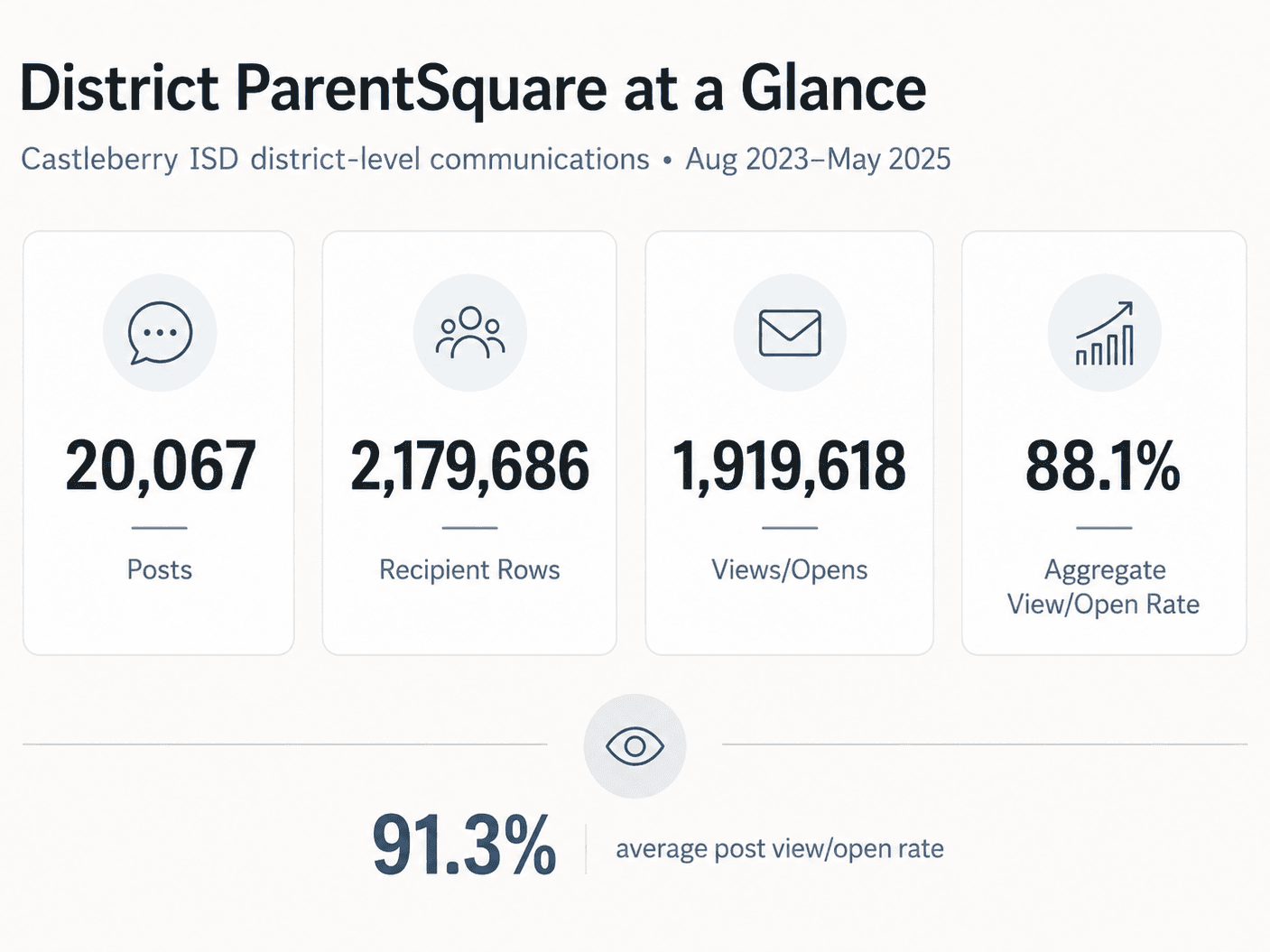
District-level ParentSquare data shows the platform carried significant direct communication volume after adoption. From August 2023 through May 2025, district-level ParentSquare posts generated more than 2.1 million recipient rows and nearly 1.92 million views/opens.
The aggregate view/open rate was 88.1%, with an average post view/open rate of 91.3%. This indicates that ParentSquare provided a level of direct-message visibility that social media could not reliably guarantee.
Direct Communication Scaled While Maintaining Strong Visibility
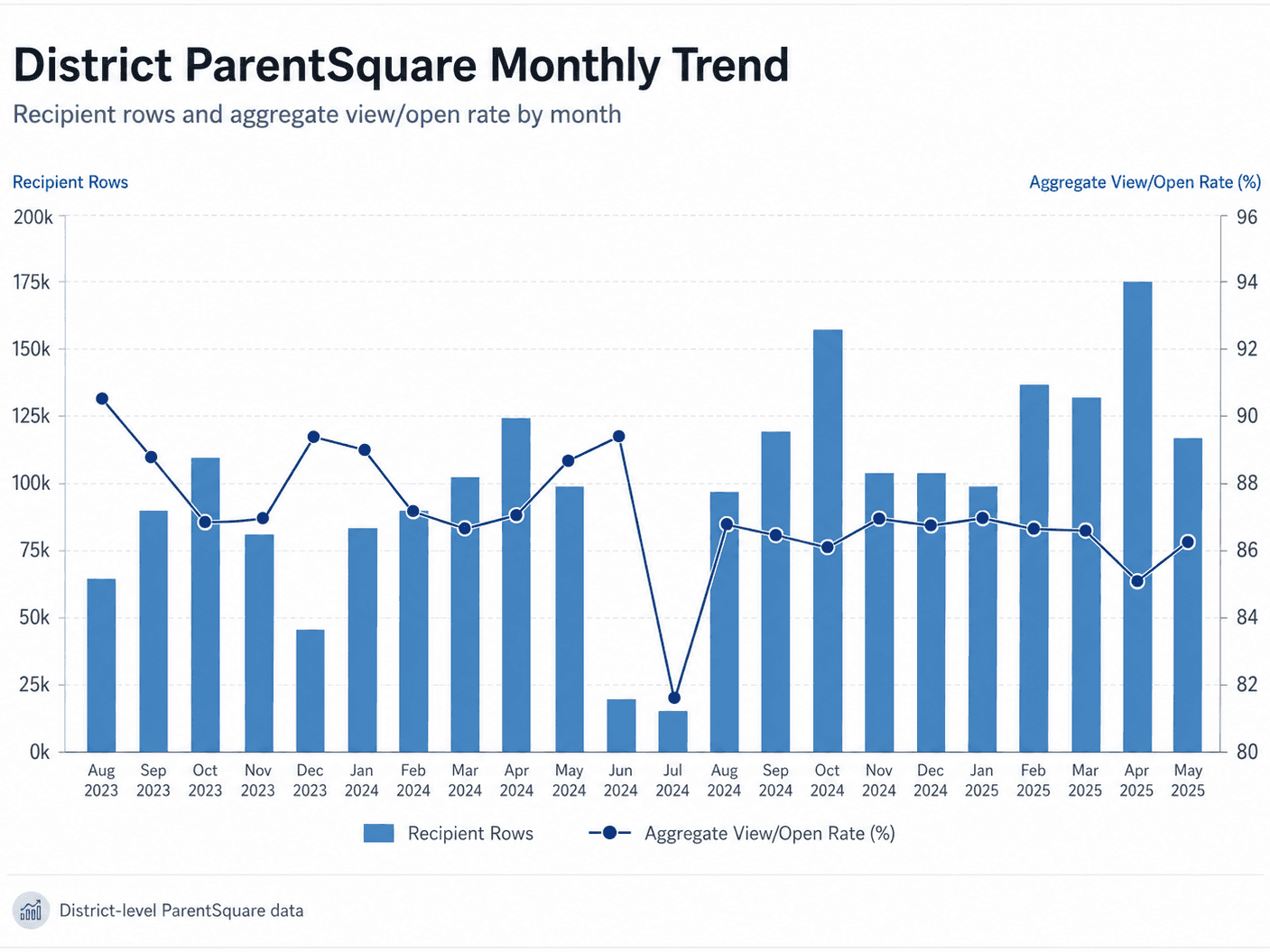
Monthly ParentSquare trends show that the platform continued to maintain strong visibility even as communication volume changed month to month. Some months carried much heavier recipient volume, especially during high-activity periods of the school year, but district-level view/open rates remained strong overall.
This supported the platform’s role as a reliable communication infrastructure channel rather than a replacement for social media.
Social Media Became More Selective and More Efficient
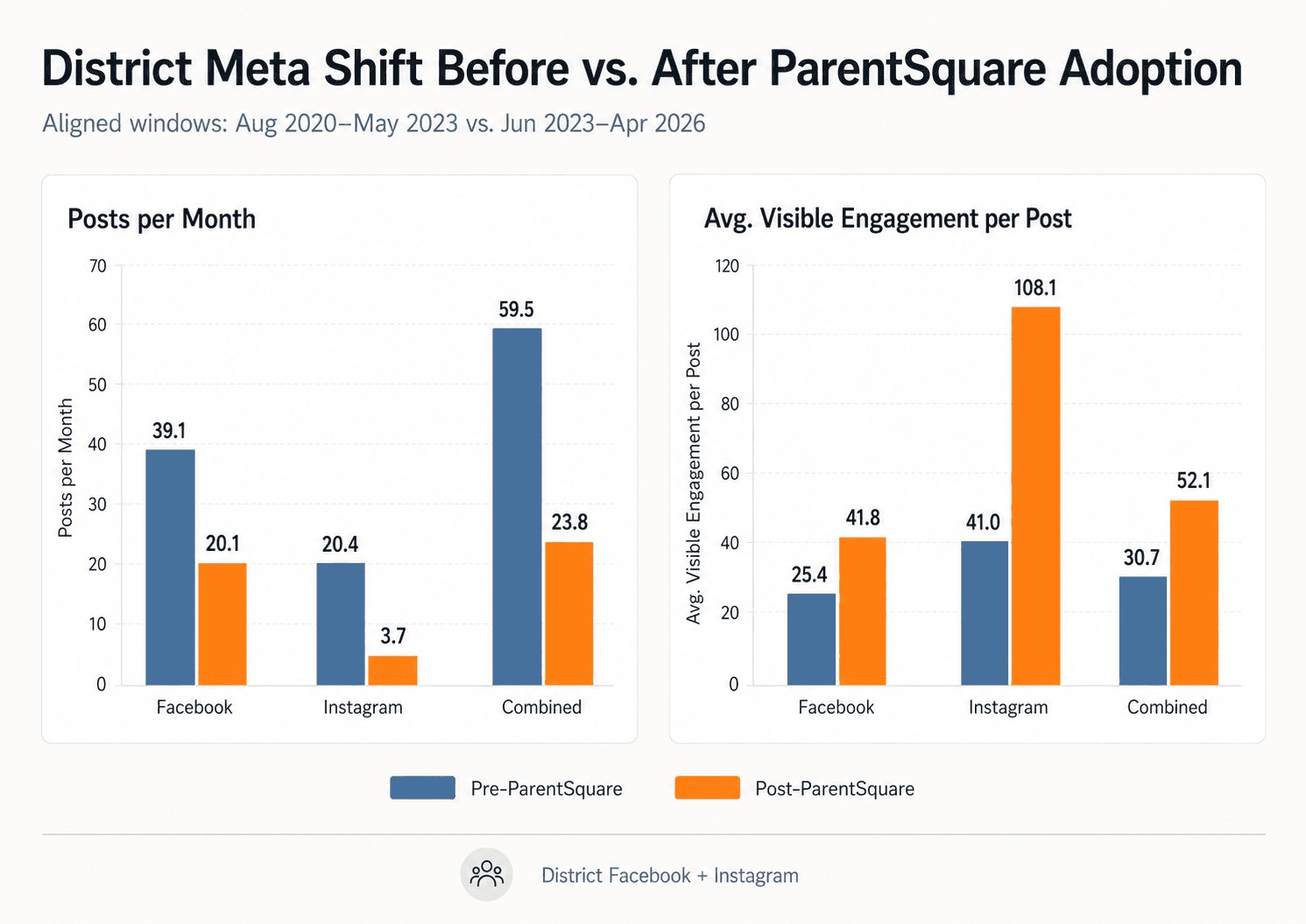
The Meta data shows a meaningful shift after ParentSquare adoption. District-level Facebook and Instagram posting volume decreased, but average visible engagement per post increased.
This does not prove that ParentSquare caused social media engagement to increase. However, the data supports a clear strategic pattern: once direct informational communication had a more reliable home, district social media could become more selective and engagement-focused.
Instead of using Facebook and Instagram to carry every reminder, update, and operational message, the district could prioritize content that was more likely to generate public engagement: stories, photos, recognition, events, and moments of community pride.
“
The strategy was not to post more. The strategy was to post with clearer purpose.
— Abigail Offenbaker

Visual Storytelling Outperformed Static Information
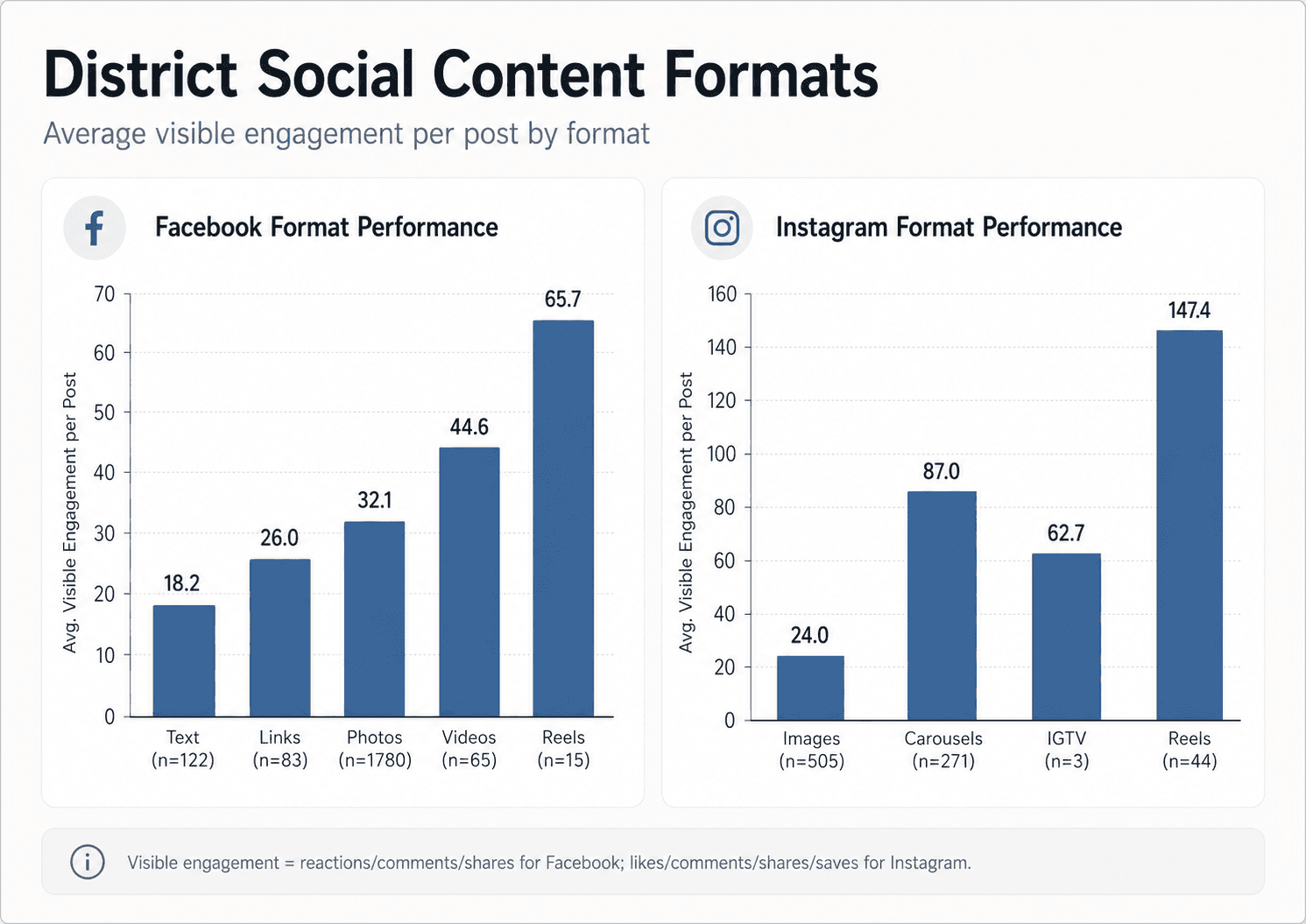
The Meta content-format analysis supports the value of visual storytelling. On Facebook, reels and videos generated higher average visible engagement per post than text, links, or standard photo posts. On Instagram, reels and carousels significantly outperformed single-image posts.
This pattern supports the broader strategy shift. Once informational communication moved into ParentSquare, social media could focus more heavily on formats that encouraged attention, interaction, and community connection.
Carousels were especially important on Instagram because they allowed for multi-slide storytelling. Instead of relying on one image or one graphic, carousels could show a fuller story through multiple photos, moments, or event highlights.
Key Findings:
The combined ParentSquare and Meta data supports four major findings.
First, ParentSquare became the district’s direct communication infrastructure.
District-level ParentSquare posts generated more than 1.9 million views/opens with an 88.1% aggregate view/open rate.
Second, audience segmentation improved communication relevance.
Many district-level posts were sent to smaller district-managed groups, where view/open rates were especially strong.
Third, social media became more focused after ParentSquare adoption.
District Meta posting volume decreased, but average visible engagement per post increased.
Fourth, visual storytelling formats performed best on social media.
Facebook reels and videos and Instagram reels and carousels generated stronger average engagement than more static formats.
Strategic Takeaway
ParentSquare delivered the information.
Social media told the story.
The data supports a clear communication model: ParentSquare handled direct delivery, while social media supported public engagement.
That distinction strengthened the overall communication system. Families and staff could receive important information through a more reliable direct channel, while public-facing social media could focus on content that built trust, visibility, recognition, and community connection.
The result was a more intentional communication ecosystem, with each platform aligned to a clearer purpose.
Skills Demonstrated
This project demonstrates experience in communication strategy, content planning, audience segmentation, platform implementation, social media analytics, executive reporting, and data-informed decision-making.
It also shows the ability to translate messy platform exports into useful business insights: identifying what the data supports, what it does not support, and how those insights should shape communication strategy.
Communication Strategy | Audience Segmentation |
Content Strategy | Social Media Analytics |
Platform Implementation | Data Storytelling |
Brand Engagement | Community Engagement |
Performance Reporting | Cross-Channel Strategy |
Data Note
This analysis uses district-level ParentSquare exports from August 2023 through May 2025 and district Facebook/Instagram exports from August 2020 through spring 2026. Meta engagement is defined as visible engagement: reactions, comments, and shares for Facebook; likes, comments, shares, and saves for Instagram.
Because platform exports can vary over time, this case study emphasizes defensible trend analysis rather than inflated claims. ParentSquare adoption and social media engagement shifts are presented as a strategic relationship, not a direct causal claim.